
Billy Kamara ART
Studio


Bio
Billy Kamara is an Egyptian-Sierra Leonean artist and creative designer based in Alexandria, Virginia. Born in 1974 to a Sierra Leonean father and an Egyptian mother, Kamara grew up in Egypt, where his multicultural background shaped an openness to different cultures, philosophies, and ways of understanding the world.
His relationship with art began at the age of four, when his father, a professor of English literature, introduced him to drawing and painting. He has been creating ever since. Inspired by the Renaissance masters, particularly Michelangelo, Kamara developed an early fascination with the human figure, realism, and the expressive power of light.
Kamara graduated from the Faculty of Fine Arts at Helwan University in Cairo in 1999 and began his professional career as a realist painter alongside his work as a graphic designer. His early paintings combined the human figure with symbolism, exploring emotional and psychological relationships through carefully constructed scenes. During this period, light emerged as a defining element of his visual language—not simply as illumination, but as a force carrying energy, movement, and meaning.
Over time, his work evolved toward a deeper exploration of the relationship between the human being, nature, geometry, and the cosmos. Portraits and figures coexist with landscapes, geometric structures, ancient and esoteric symbols, and fields of color and light. Works such as The Tetrahedron — Kiss of Infinity and The Moon Receiving Sunlight reveal his continuing interest in the exchange of energy between visible and invisible worlds.
In his more recent work, including the Sun Impression series, Kamara explores light as a universal language. Drawing from ancient Egyptian imagery, sacred geometry, nature, astronomy, and the symbolism of the zodiac, he creates figures that appear to receive, filter, balance, and transmit cosmic energy. The paintings are not intended as illustrations of individual symbols, but as interconnected visual philosophies in which the human body, consciousness, nature, and the universe become part of one energetic system.
Kamara's artistic practice has also expanded beyond the canvas into sculpture, spatial and geometric design, and immersive environments. Across these disciplines, he continues to investigate how geometry, color, reflection, and light can influence human perception and create experiences of balance, connection, and contemplation.
Kamara has participated in numerous solo and group exhibitions in Cairo, Alexandria, and Luxor, Egypt, and has exhibited in Washington, D.C. and throughout the metropolitan area. His work is held in private collections and has also appeared in theater productions, music videos, commercials, and multidisciplinary creative projects.
At the center of Kamara's practice is an enduring pursuit: to make the invisible visible—using light, form, geometry, and symbolism to explore the energies connecting humanity, nature, and the universe.

Sun Impression on Zodiacs

Sun Impression on Aries
Sun Impression on Aries portrays consciousness as a living exchange between the human being and the universe. Crowned with two opposing horns—one red with the fire of the Sun, the other silver-blue with the reflection of the Moon—Aries stands between the forces of receiving and projecting, intuition and action.
The golden coils at the ends of his crown invisibly connect to the gemstone resting upon his chest, forming a continuous circuit of energy through body, mind, and cosmos. Around him, layers of color become the vibration of his environment: absorbed, filtered, measured, and brought into balance before rising again through the crown.
Through the lunar horn, he listens. Through the solar horn, he speaks.
Sensitive to the stars yet grounded in his own inner authority, Aries transforms what he receives into vision, creativity, and movement. His power is not simply the force to begin, but the ability to take the invisible energies surrounding him and give them direction.
Here, Aries becomes the king of the zodiac—not as a ruler above others, but as the first impulse of consciousness: the fire that leads, creates, and carries possibility from the universe into human experience.

Sun Impression on Libra
The Sun enters Libra not to divide the world into equal halves, but to awaken the invisible center between them.
Within its golden circle, a face rests in stillness, crowned with olive leaves. It is the quiet center—the place within consciousness where opposing forces recognize that they were never truly separate.
From this center, life rises.
Two intertwined stems ascend like a Caduceus, carrying consciousness upward and blooming into two faces: masculine and feminine, reason and intuition, the right and left movements of the mind. They turn away from one another, yet they grow from the same root.
From their breath emerge spirals of living energy, descending toward the two plates of the scale. One answers the other. One rises as the other falls. Balance is born not from stillness, but from their eternal conversation.
Behind them, the sky dissolves into geometry. Hexagons multiply like a hidden architecture of the universe, while red triangular sparks of sunlight appear within the pattern—as though the great Sun at the center has scattered fragments of itself throughout creation.
Everything begins from one source and returns to one source.
The masculine and feminine, the rational and intuitive, light and shadow, movement and stillness—all are expressions of the same consciousness seeking its center.
In Sun Impression on Libra, balance is not the absence of opposition.
It is the moment when two become aware that they are one.

Sun Impression on Virgo
Golden solar energy radiates through a network of intersecting circles, forming the Vesica Piscis—the sacred womb of creation, balance, and renewal. At its center, an Egyptian-inspired Virgo emerges from the microscopic patterns of Earth's living green. Through sacred geometry, texture, and symbolism, the painting reflects the interconnectedness of nature, feminine wisdom, and the creative force that unites the earthly and the cosmic.
-
The Sun as the source of life and consciousness.
-
The Vesica Piscis as the womb of creation and sacred balance.
-
Virgo representing discernment, fertility, healing, and the Earth element.
-
Egyptian-inspired imagery, connecting the work to ancient wisdom.
-
Microscopic organic greens, suggesting that the same patterns exist from the cellular level to the cosmic level.
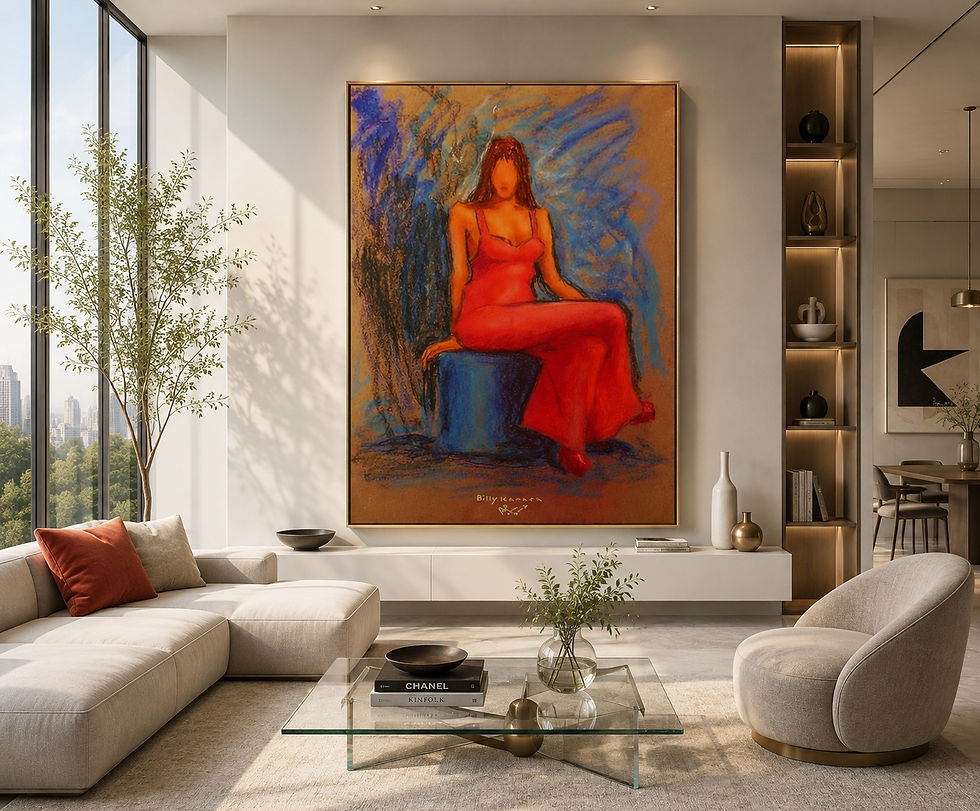
The Red Dress Model
The Red Dress Model explores the changing presence of a woman through a recurring figure dressed in red. Across the series, her identity gradually gives way to gesture, movement, color, and emotion. She stands, sits, turns, walks away, and sometimes seems to dissolve into the space around her.
The red dress becomes the constant—a visual memory moving through restless fields of blue, violet, and shadow. More than portraits of a model, these paintings trace the shifting relationship between observation and imagination, between the physical figure before the artist and the figure that remains afterward in memory.
The Red Dress Model 1

The Red Dress Model 2

The Red Dress Model 3

The Red Dress Model 4

The Red Dress Model 5

The Red Dress Model 6
The Red Dress Model 7

The Red Dress Model 8

The Red Dress Model 9

The Red Dress Model 10


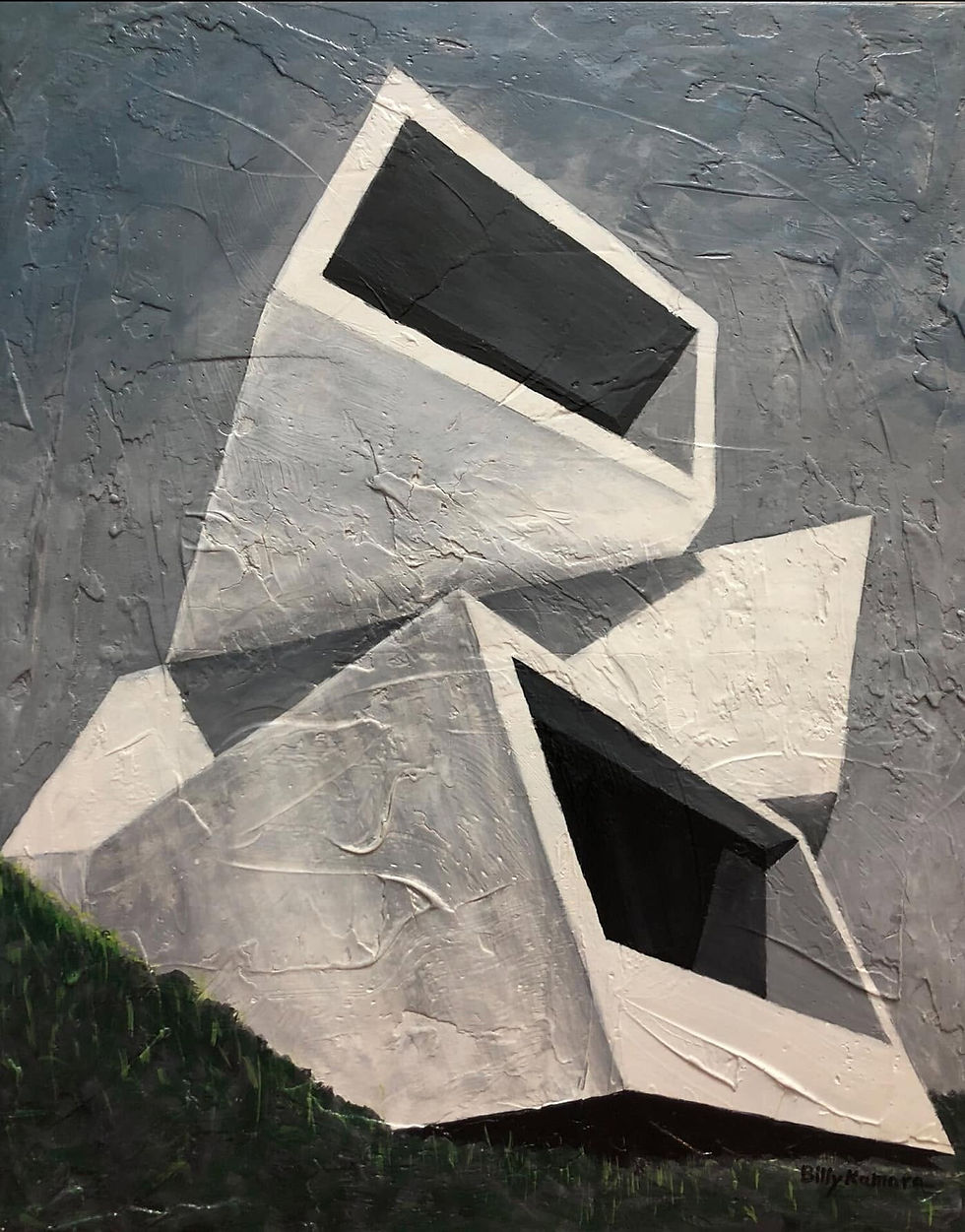
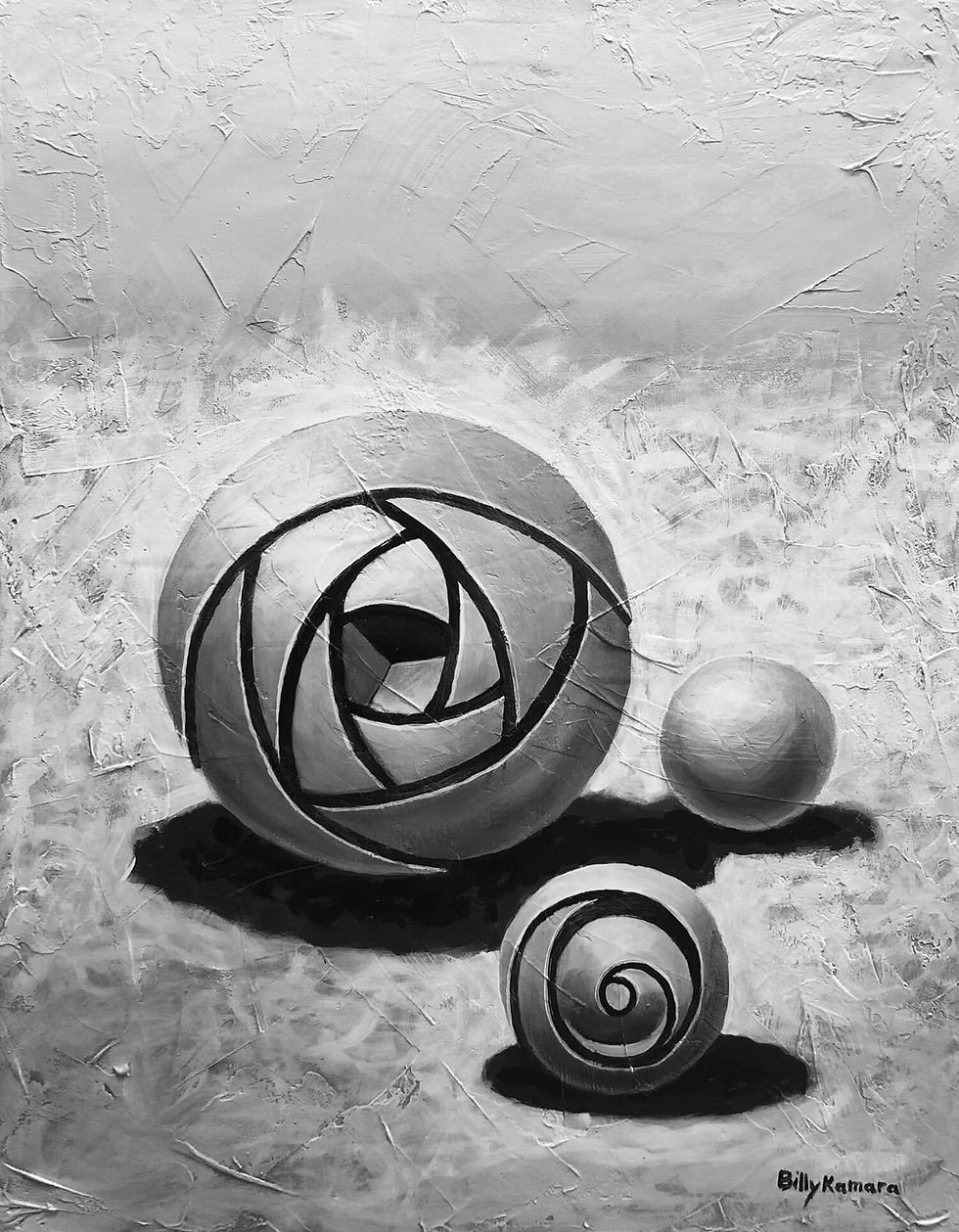
Minimal View
Minimal View explores the quiet relationship between geometry, architecture, light, and space. Simple shapes become imagined structures and environments, suspended somewhere between object, architecture, and landscape.
Through a restrained palette, textured surfaces, and carefully constructed light and shadow, familiar geometrical forms take on a new presence. The works invite the viewer to look at less and imagine more—to experience how simplicity can create space for balance, mystery, and contemplation.
Minimal View 4

Minimal View 8

Minimal View 6

Minimal View 2

Minimal View 1

Minimal View 10

Minimal View 7

Minimal View 5

Minimal View 3

Minimal View 9




UNITY
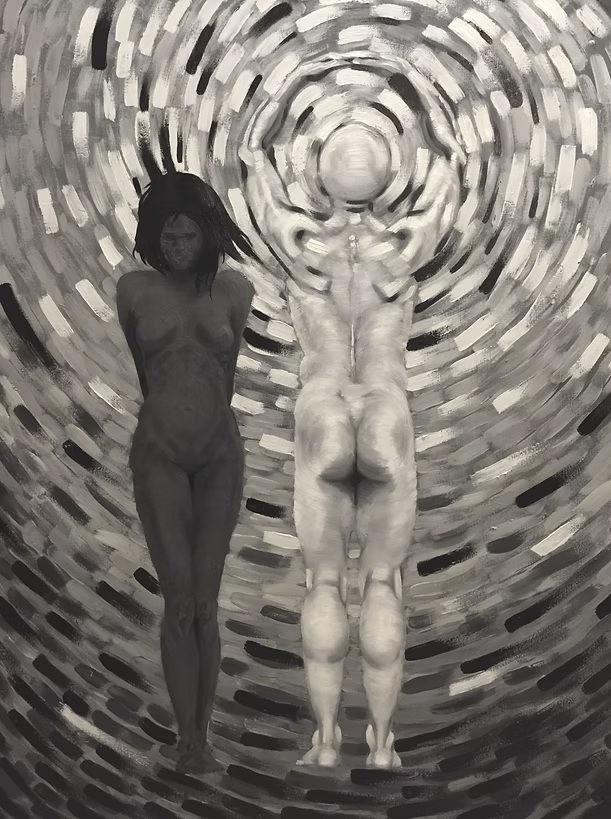
Unity explores the relationship between opposing forces—not as enemies, but as complementary energies belonging to the same source.
Light and darkness, positive and negative, masculine and feminine, giving and receiving: each carries a different nature, yet neither is complete without the other. Like two sides of the same coin, their differences are part of a larger balance through which nature creates, transforms, and continues itself.
Throughout this collection, I use the male and female figures as a visual language for these forces. Their bodies meet, mirror, support, oppose, and flow through one another, transforming the human relationship into a symbol of something larger than the individuals themselves.
Geometry, circular movement, reflection, and repetition surround the figures as signs of an underlying order—a suggestion that what appears divided may, at a deeper level, belong to one continuous energy.
For me, Unity is ultimately about this hidden relationship between opposites: the moment when two different forces stop being understood as separate and reveal themselves as expressions of one whole.
Kiss of infinity

Kiss of Infinity. kiss can be more than a moment of affection. It can become a silent contract—a promise of love, care, and connection that reaches beyond the boundaries of time.
In Kiss of Infinity, two bodies move toward one another from opposing directions, curving into a continuous circular motion. Their differences remain, yet through their connection they begin to form something greater than either figure alone.
At the center is the kiss: a small and intimate point of contact surrounded by an infinite movement of energy. Beginning and ending become difficult to distinguish, as though one body continues through the other.
For me, the kiss becomes a symbol of a bond that does not belong only to this moment or even to this lifetime. It carries the hope that love can continue—through change, through separation, through life, and perhaps beyond it.
The kiss is deeper than we think. It is a moment where two become one without losing themselves.
First of February

First of February
Not every moment of a relationship feels like unity.
There are seasons when two people can stand beside one another and still feel far apart—when communication becomes cloudy, warmth disappears, and something that once felt certain becomes difficult to reach.
First of February uses winter as a metaphor for those moments. February can be cold, unstable, filled with rain, snow, and changing skies. The sun is still there, but it feels distant—sometimes hidden completely behind the atmosphere.
The two figures occupy the same space, yet they seem emotionally separated. One withdraws into darkness while the other reaches toward a distant light, as if searching for warmth, clarity, or an answer. Around them, circular movement continues, suggesting that even this difficult moment belongs to a larger cycle.
Quarrels, misunderstandings, separation, and even the ending of a relationship can feel like winter. But winter is also a season, not the whole story.
First of February is about that fragile time when unity becomes uncertain—when love may still exist, but its warmth can no longer be clearly felt.
THE TETRAHEDRON I

The Tetrahedron1 explores the human body as an expression of sacred geometry and the creative force within relationship.
The star tetrahedron is formed by two interpenetrating tetrahedra—one extending upward, the other downward. In esoteric traditions, these opposing forms have been associated with complementary forces such as fire and water, masculine and feminine, above and below. Their union creates not the disappearance of difference, but a new and balanced form.
In this painting, I wanted to take that geometry out of the diagram and embody it.
The male and female figures become the structure itself. Their bodies intersect, support, receive, and extend through one another, physically constructing the geometry of union. What may first appear sexual is intended to lead beyond sexuality toward its deeper creative meaning.
Sexual energy, to me, is not separate from the mystery of creation. Through the intimate union of two human beings, the possibility exists for another consciousness, another body, another life to enter the world. In that moment, we participate in creation—we become co-creators.
For this reason, I see sexuality as something powerful and worthy of reverence. Within a loving and conscious relationship, intimacy can become more than physical desire; it can become an exchange of energy, trust, vulnerability, and creative potential.
The geometry surrounding the figures is therefore not decoration. The bodies are the geometry. The relationship is the geometry.
The Tetrahedron I asks us to look beyond the naked body and recognize the larger structure taking place: two opposing forces entering one another, balancing one another, and becoming a vessel through which creation can flow.
THE TETRAHEDRON II

The Tetrahedron II
The Tetrahedron 2 continues the philosophy of The Tetrahedron I, but observes the same union from another perspective.
If the first painting embodies the star tetrahedron through the direct intersection of two human forms, this painting turns that structure—as though we are looking at the profile of the geometry hidden within the Star of David.
The male and female bodies again become the geometry itself. Their limbs extend in opposing directions, crossing and supporting one another while forming a single interconnected structure. Behind them, triangular planes expand outward, revealing the geometric order that their bodies are already expressing.
What changes is the viewpoint, not the principle.
A sacred form does not lose its identity when we move around it. Its appearance changes, new relationships become visible, and dimensions that were previously hidden begin to reveal themselves. I see human relationships in much the same way. Two people can experience the same connection from entirely different positions, yet still participate in one shared structure.
Here again, intimacy becomes a creative force. Masculine and feminine, giving and receiving, movement and stillness intersect—not to erase their differences, but to create balance through them.
The Tetrahedron II is another view of the same mystery: two bodies, two forces, and two perspectives becoming the architecture of one form.
The Moon Receiving Light

The Moon Receiving Light
The moon does not create the light we see upon it. It receives light from the sun, holds it, reflects it, and when darkness arrives, becomes a source of illumination for others.
The Moon Receiving Light uses this relationship as a metaphor for human connection.
Throughout our lives, we are both suns and moons to one another. At certain moments we give—love, knowledge, strength, experience, inspiration. At other moments we receive. What enters us through another person can mature within us until, eventually, we are able to reflect that light toward someone else when their own sun feels far away.
In this sense, none of us becomes illuminated alone. We exist like a human galaxy, continuously receiving and transmitting energy through one another.
But receiving light also carries responsibility. Knowledge can heal or harm. Love can liberate or possess. Power can create or destroy. Like a sword with two edges, what we receive does not determine what we become; we choose how that energy will pass through us.
For me, maturity is not simply becoming full of light. It is learning how to receive it consciously, transform it within ourselves, and return it to the world with wisdom.
The Moon Receiving Light is ultimately about this cycle of human illumination: we receive, we grow, we reflect—and in different moments of life, each of us becomes someone else's sun and someone else's moon.



THE RETURN
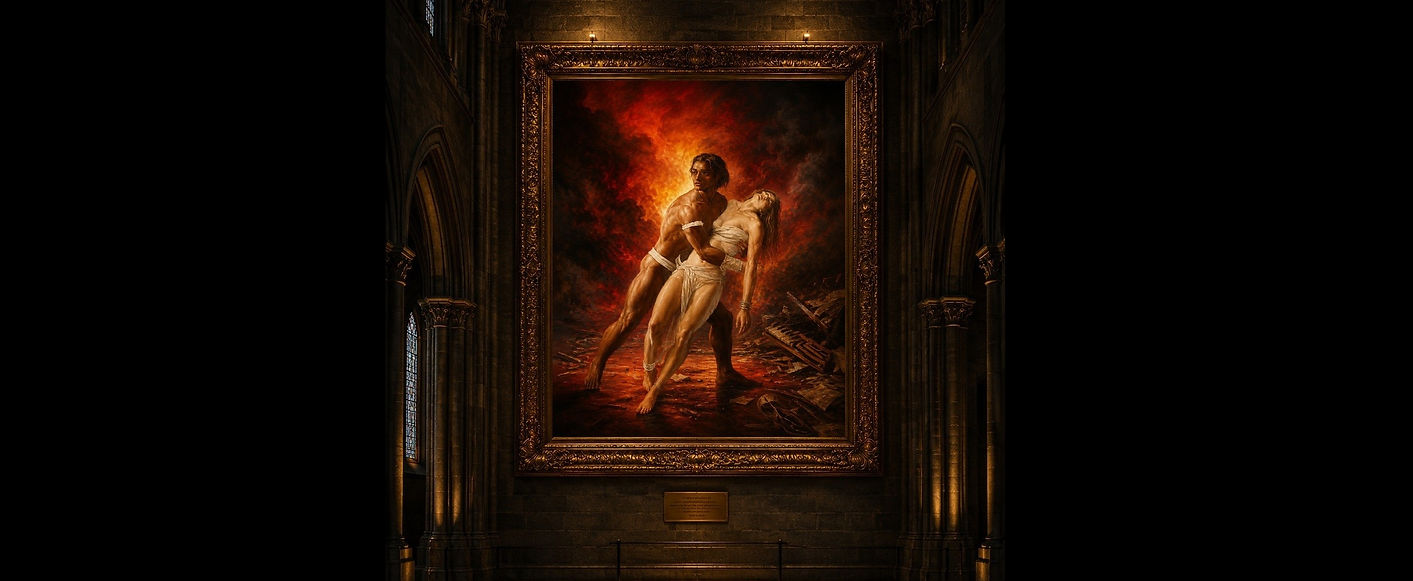
The Return follows a warrior struggling to protect his family during the collapse of the world. Armed with faith, knowledge and physical strength, he believes he can defend those he loves—until the death of his woman confronts him with the limits of human power.
After years of solitude, he witnesses the return of Jesus and joins the final struggle against evil, while his son reaches toward a distant light suggesting the possibility of a new beginning.
The final painting, Immortal Life!, leaves the narrative with a crowned skeleton upon a throne—a reminder that even kings surrender their earthly power to death. What may endure instead are the invisible things accumulated within us: service, love, sacrifice and courage.
The Return is ultimately a journey from power to loss, loss to faith, and mortality toward the hope of immortal life.
Warrior of God

Protective Attitude

Dramatic lost
Blessing for Light

Immortal Life

I originally called this painting Every King Dies! Later, I changed the title to Immortal Life! The change represents an evolution in the meaning of the entire series. Death is certain, but perhaps death is not the final measure of a life.
Lost Work — title unknown
One painting from the original series has been lost. It represented the darker side of humanity and the forces opposed by the warrior.


